
Insights
Who decides during a managed-service incident?
A practical rehearsal for GCC businesses and their IT providers, from the first alert to an accountable handover.
Share this insight
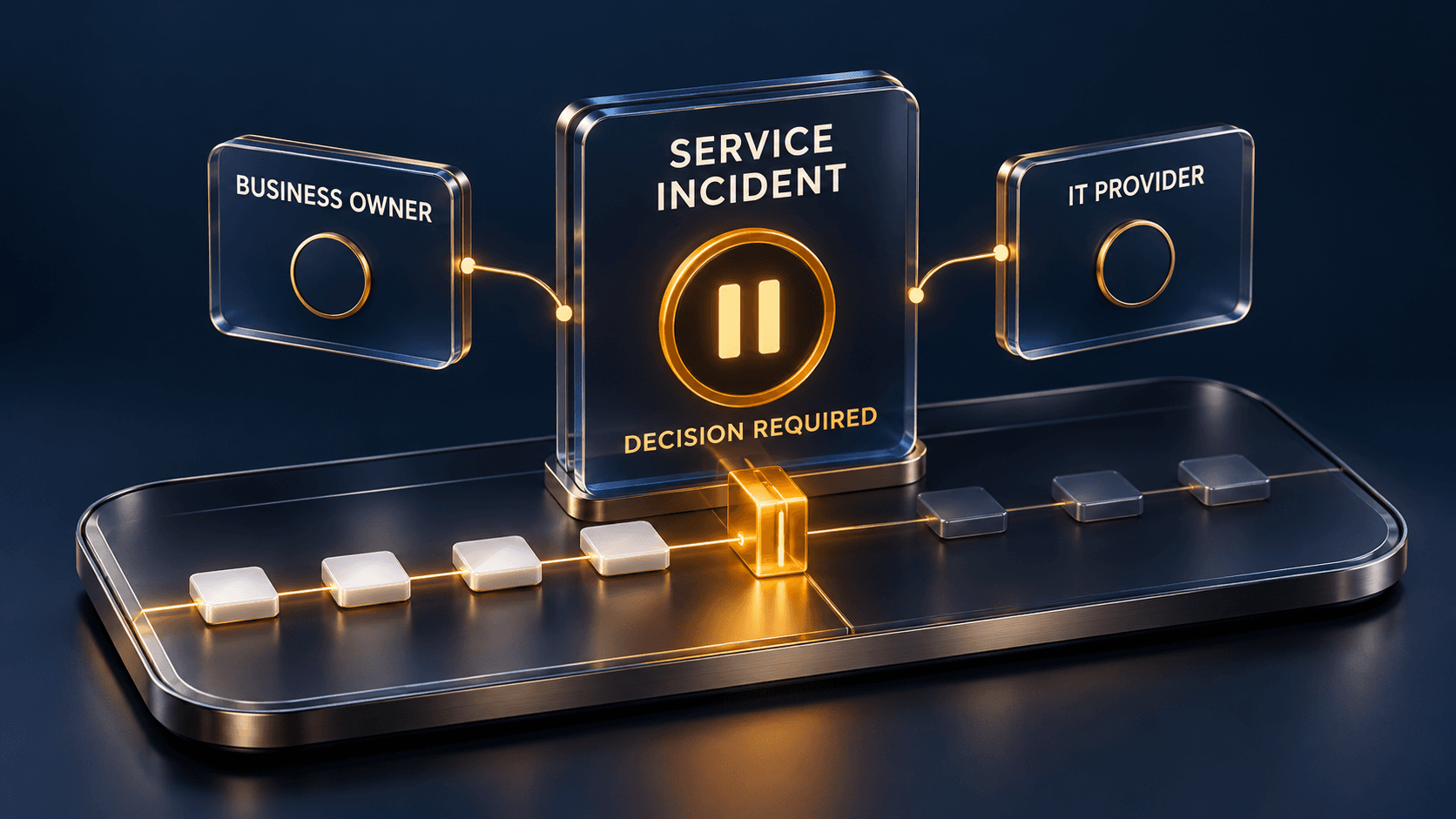
Rehearse decision authority
A managed-service agreement can identify the support team, set response targets and explain escalation. It may still leave someone unsure whether they can contain a suspected attack when that action would also stop an important service.
For a GCC enterprise relying on an external IT provider, that decision deserves a rehearsal with the people who would make it. Bring the provider's incident lead and your operational decision-maker into the same exercise. Give them a plausible service failure and incomplete evidence. Ask for a decision that would affect operations.
Leave with a decision-and-handover record: the authority to act, the information needed for each decision and the deputy who can take over.
Why rehearse with the provider?
In July 2026, the UK's National Cyber Security Centre published response and recovery guidance that stresses practising response arrangements and testing recovery. Its focus on business-led recovery is useful when technical restoration and operational priorities pull teams in different directions.
NIST's April 2025 incident-response publication includes suppliers and relevant third parties in incident planning, response and recovery. It also identifies exercises involving third parties as a way to find improvements.
These are UK and US guidance sources, not GCC legal requirements. The rehearsal below is a proposed management exercise, not an official standard or evidence that a particular organisation can recover.
This article follows our guide to selecting a managed DevSecOps provider. Here, the contract is already in place. The customer and provider are testing how their responsibilities work together during an incident.
Start with one service and an awkward decision
Choose a service whose disruption has a clear business consequence. Record the service owner, the provider's scope and any separate software vendor before writing the scenario. Keep the discussion within that service's dependencies and operating decisions.
Here is an illustrative scenario for a fictional facilities-maintenance business operating in the Gulf. Its portal receives service requests and passes approved jobs to a dispatch system. A managed provider supports the integration. Dispatch supervisors own the daily work schedule.
The portal is still accepting requests, but some jobs are not appearing in dispatch. At the same time, the provider detects unusual activity involving the integration account. The software vendor's public status page reports normal operation.
The cause is unknown. The unusual activity may be related to the missing jobs, or the two issues may have different causes. The team must consider both availability and security while it investigates.
The provider proposes temporarily disabling the account. That could limit further unauthorised activity, but it would also stop new jobs reaching dispatch. Keeping the account active could preserve service while leaving a suspected exposure unresolved.
Ask the participants to make a decision with the information available. Check the provider's authority to take the proposed action. Where customer approval is required, identify the approver and ask how urgent field work will continue.
All details in this scenario are invented for discussion. They do not describe a Bridges client or establish response-time, recovery or security targets.
Agree who can act before the exercise starts
Name the customer incident lead and a deputy. Give the provider a corresponding lead with a route to someone authorised to commit its response resources. The operational owner should be available to explain the consequences of an interruption and approve the business trade-offs within their remit.
The agreement should already specify any actions the provider may take without further approval, their limits and the required notification. The exercise checks that both teams interpret those terms consistently. It must not silently expand the provider's authority.
The Canadian Centre for Cyber Security's managed-services guidance, last modified in October 2020, highlights the need to coordinate incident plans and clarify responsibilities. Its observation that provider and customer priorities may differ is particularly relevant when a provider supports several affected customers.
Treat this older Canadian guidance as a useful planning reference. Accountability under a particular contract or local law still needs to be established for that organisation.
A small customer team may assign several roles to one person. The exercise should expose the resulting dependency: if that person cannot be reached, which decisions can a deputy make, and which actions remain outside their authority?
Run a focused, 60-minute discussion
The following hour-long format is an editorial proposal. Adapt the duration and participants to the service. Use synthetic records and a controlled discussion; do not disable a production account or send an actual customer alert as part of this tabletop.
First 10 minutes: establish what is known
Give both teams the same opening facts. Ask each to explain the affected service in business terms. A technical statement such as “the integration is failing” should become an operational question: which jobs might be missing, and how will supervisors identify urgent requests?
Separate confirmed observations from assumptions in a shared record. The vendor's green status page is one piece of information; it does not establish that this customer's end-to-end service is functioning.
Agree who gathers each missing fact and when the next update will occur. Make that update time an exercise decision, not a response promise invented by the facilitator.
Next 20 minutes: decide what can be paused
Introduce the provider's recommendation to disable the integration account. Ask the authorised participants to state their decision, its scope and the reason for it.
If they pause the integration, who activates the agreed manual intake or dispatch process? If they keep it operating while investigating, who accepts that temporary exposure and what would cause the decision to change? The scenario should allow either answer to be challenged against the available evidence and actual authority.
Then make the customer's usual approver unavailable. Observe whether the deputy arrangement works. If no authorised person can be reached, record the gap and the permitted emergency action; do not assume that a support technician can accept the business risk.
Next 15 minutes: practise the handover
Introduce a shift change or the need to involve the software vendor. Ask the next responder to take over using only the written incident record.
They should be able to identify the current service restriction, the evidence behind it, the decision owner and the next action. Include the investigation's unanswered questions. A handover that drops uncertainty can turn a tentative explanation into an accepted cause.
Test the agreed alternative communication route if the usual collaboration service is unavailable. Confirm who is permitted to receive technical evidence and personal information; use synthetic material during the exercise.
Final 15 minutes: decide what must change
Ask the group to show which decisions it could make within the current arrangements. Capture unresolved dependencies as specific actions with an owner and completion date.
“Improve communication” is too vague. “Add the provider's out-of-hours incident lead to the agreed call route, verify it with both deputies and rehearse that contact step again” gives someone work they can complete.
Close with the observed gaps and agreed changes, including the evidence needed to check each change. A general confidence score would leave those details unresolved.
Keep a decision record that survives a handover
The following is a proposed record for the fictional scenario. Replace role names with actual people and authorised deputies in the organisation's working version. Store it in an agreed location accessible during the incident, with appropriate access controls.
| Decision or handover | Owner to identify in advance | What the next responder needs |
|---|---|---|
| Pause the integration | The person authorised under the contract and customer incident arrangements | Scope, reason, time, approver and conditions for reconsidering the pause |
| Continue urgent field work | Customer operational owner | Approved fallback, work affected, supervisor instructions and unresolved requests |
| Involve another supplier | Lead responsible for the dependency | Supplier case reference, evidence shared, outstanding request and next update |
| Communicate externally | Designated customer communications lead with legal or privacy input when needed | Verified facts, intended audience, approval and a record of what was sent |
| Hand over the incident | Outgoing and incoming incident leads | Current state, actions taken, open questions, decision owners and the next checkpoint |
A ticket number alone will not tell a replacement responder why an account was disabled or who can authorise a different action. Include the decision's reasoning so that the next responder does not have to reconstruct it from separate chat threads.
For real incidents, the designated legal, privacy and communications teams must establish applicable notification duties and deadlines. These vary with jurisdiction, sector, facts and contractual commitments. This article sets no common UAE, Saudi or GCC reporting deadline.
Separate the tabletop from technical proof
A tabletop can show that nobody knows how to reach the software vendor after hours. It cannot prove that a backup restores correctly, that logs contain the necessary evidence or that a manual dispatch process has enough capacity.
List those technical or operational checks separately. Plan and authorise them with the relevant owners, including safeguards for production systems and personal information. Record what was actually tested and what remains an assumption.
The UK's NCSC provider-selection guidance, published in November 2025 for smaller organisations, recommends clear provider responsibilities and incident-reporting expectations. A rehearsal can expose a gap in those arrangements; changing the contract, access or service scope requires the appropriate approval.
Recovery also has its own acceptance decision. Restored connectivity does not establish that all work is accounted for. Our post-outage reconciliation guide covers that later problem. Here, the rehearsal should identify who will own the recovery decision and what information they will need.
Questions to resolve with the provider
Does the provider's incident plan cover our business?
Ask to see where your service, contacts and retained responsibilities appear in the joint arrangements. The provider may have an effective internal plan while relying on customer decisions that have never been exercised.
Should we require a specific response time?
Agree timings according to service impact, coverage and the contract. Distinguish acknowledging an alert from assigning a responder, taking an authorised action and restoring a usable service. The exercise should expose ambiguity between those commitments; it does not create a universal target.
How often should we rehearse?
Set a cadence based on service criticality and relevant obligations. Also consider another exercise after a major supplier, service-scope, contact or authority change. The sources used here do not establish one mandatory GCC-wide schedule.
What should we do next?
Choose one important service and invite its operational owner and the provider's incident lead to work through a scenario together. Prepare the current authority arrangements first, then leave with named owners for the gaps the exercise exposes.
Bridges' Managed IT & Cloud Operations, Cybersecurity and Business Continuity & Resilience services are relevant to this work. To discuss a rehearsal, contact Bridges with the service you want to test and the decision that needs clarifying.
Related perspectives & expertise
Resilience
Cybersecurity
Understand your exposure and build security into the systems, operations and decisions that matter.
ExploreResilience
Managed IT & Cloud Operations DevSecOps
Build dependable cloud foundations and a clear operating model for critical technology.
ExploreResilience
Disaster Recovery, Business Continuity & Resilience
Prepare critical operations to withstand disruption, recover deliberately and learn from testing.
Explore
Technology operations
Managed DevSecOps: The Evidence to Ask For Before You Sign
Use one release and one failure scenario to evaluate secure delivery, operational ownership and recovery before choosing a managed DevSecOps partner.
Explore
Operational resilience
The Systems Are Back. Is the Business Ready?
How to reconcile orders, payments and work completed during an outage before restarting automation.
Explore